
Cannabis and Creativity: The Secret Weapon of Writers, Painters, and Game Developers
For artists, writers, and game designers, creativity drives their ambitions. To keep fresh, original, and inspired, creators frequently search for ways to increase their potential to innovate. And while it may seem unconventional, and even anti-culture, cannabis has been a non-conventionally embraced method of enhancing creativity for centuries. Historically, cannabis has found its place in the counterculture phenomena, but nowadays, cannabis is being accepted by more mainstream creative professionals as a real catalyst to upend creative blockages, gain novel perspectives on ideas, and hence, rethink how they might approach tasks altogether.
Why do so many successful creators endorse a cannabis-embedded creative process?
According to research, cannabinoids, and THC in particular, interact with the brain’s release of dopamine, as well as enhance relaxation, and also reduce inhibitions. By releasing mental tensions, something about cannabis can help creators with exploring unconventional ideas that a sober mind may censor for being imprudent, or irrelevant. Put another way, cannabis, by reducing internal resistance, helps creators in establishing more free-flow connections of ideas, visualization, and narratives in novel and productive ways.
Creators, which have attributed their breakthroughs to cannabis
The legendary astrophysicist Carl Sagan contemplated using cannabis as the thought agent in some of his essays written anonymously. Amongst other musicians, Bob Dylan and Louis Armstrong acknowledged cannabis as enlarging their musical expression. Even Steve Jobs reported using cannabis, particularly in studies that led to perspectives and inventive leaps he engaged in with Apple.
Writer Stephen King has discussed using cannabis to quiet their internal critic so they could dig down deeper into the story. Cannabis can make rigid outlines or plot structures fuzzy and can lead writers to unexpected narrative paths or avenues for authentic dialogue. Additionally, as cannabis reduces anxiety and fear of criticism or failure, writers allow themselves to write with more courage.
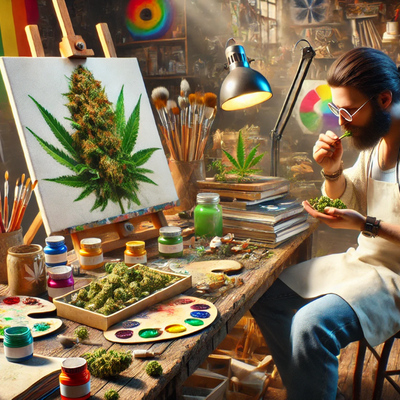
Visual artists, historically including Salvador Dalí and contemporary street artists, often say cannabis allows them to see colors, textures, or spatial relationships more vividly. Artists talk about being more aware of visual nuances or subtleties that each day they might not notice. Cannabis, through enhanced sensory perception, leads the creator to new experiments and playful redefinitions on a canvas. This can require an artist to grow their own style and process.
For game developers, cannabis can turn an engineering process into exploring art. Game design blends storytelling, graphic design, user experience, and complicated mechanics. A game developer might use cannabis to facilitate lateral thinking, which is especially important for solving complex coding puzzles or developing gameplay. Cannabis can allow a game developer to set aside cognitive, linear, or overly analytical problem-solving, and find a more intuitive solution. Notably, many indie developers use cannabis as part of the brainstorming process for new ideas to become innovative gameplay mechanics to make their games stand out in crowded times.
But the effective use of cannabis for creativity lies in fairly productive consumption and mindful integration into the creative process. Consuming high quantities of cannabis can dull creative instincts and lead to a feeling of tiredness, boredom, lethargy, and confusion. These guidelines can help the creative mind find new pathways with cannabis but not get lost in consumption:
- Microdose: As much as possible, choose small doses to reduce doses of confusion; maintaining mental sharpness and clarity.
- Choose cannabis strains carefully: Sativa-dominant strains that can increase focus, energy, and imagination can help.
- Mix cannabis with journaling or sketching: You can document and should be able to demonstrate those fleeting creative insights.
- Experiment gradually: This way, you can find your own balance and dosage.
Cannabis is neither guaranteed to improve creativity nor a panacea for all creative entanglements. But when used with intention, it has the potential to be a creative booster. The difference is how cannabis is used, not as a crutch but thoughtfully and with moderation, making it highly valuable to the creative process.