
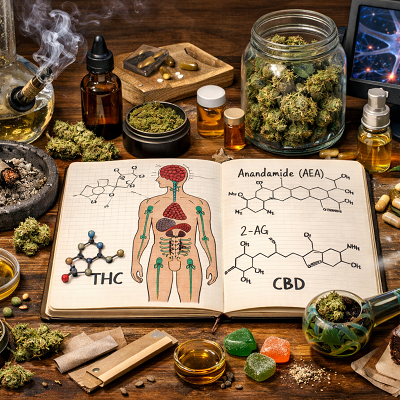
The endocannabinoid system: how weed works inside of you
Do you know how the smallest plant on earth can affect what you eat or how often you laugh at memes? Well, the answer isn’t just the weed; it’s inside of you.
You have something called an endocannabinoid system (ECS) which is probably the most critical physiological system you weren’t taught about in school.
What is the ECS? (your internal balancer)
Think of your body as one huge hotel. There are thousands of systems: heating (temperature); lighting (mood); room service (appetite); security (immune response); etc. The ECS is the general manager of this hotel. His only job is to keep things in homeostasis – so that everything stays perfectly balanced.
Component | Role | Fun Fact |
Endocannabinoids | The “Keys” | Your body makes these naturally (like Anandamide). |
Receptors | The “Locks” | Tiny docking stations (CB1 and CB2) found all over your body. |
Enzymes | The “Cleanup Crew” | These break down the “keys” once the job is done. |
Despite this progress, the recreational use of cannabis remains illegal, and the market for medical cannabis is tightly regulated. Companies must navigate stringent regulations and licensing processes to cultivate, import, and distribute cannabis products for medical use.
The Locks: CB1 vs. CB2
When THC is introduced into your blood stream, it searches out two specific types of “locks” to enter with their “key”.
- Cb1 receptors: primarily in the brain and central nervous system. They control memory, movement, appetite, and that high feeling you get when you use cannabis.
- Cb2 receptors: primarily in the immune system and peripheral organs. They regulate inflammation, pain, and immune response.
So why does weed “actually” work?
Here is the secret: the molecular shape of THC is very similar to your internal neurotransmitter, Anandamide (also known as the bliss molecule).
Your body creates Anandamide on-demand, but then breaks it down immediately. When you smoke, you are basically hacking the system. THC overwhelms your cb1 receptors, and your “general manager” goes crazy, sending messages such as: “Food is amazing”, “music is deeper”, “forget about stress”.
THC vs. CBD: two methods to achieve balance
- THC is like a direct guest. It comes in, takes the cb1 receptor chair and presses all the buttons.
- CBD is more like a consultant. It does not usually take the chair. Instead, it stays out the way of the “cleaning crew” (the enzymes) that break down your own natural Anandamide. This is why CBD helps you feel better without intoxication.
“THC mimics your body’s signals while CBD allows your own signals to last longer and function better.”
Pro tip: tolerance & ECS
Have you ever noticed that after a month of daily smoking, you need twice as much cannabis for the same effect? That is because of your ECS.
When your cb1 receptors are constantly bombarded by THC, your brain decides there are too many signals coming in. So it literally places some of the locks inside your cells (downregulation). Less locks = lowered high.
Good news: your ECS is very adaptable. A short t-break (48-72 hours) will allow your brain to place those receptors back outside where they belong and you’ll be sensitive again.
Why this matters
Learning about your ECS will turn you from a casual user into a conscious one. At this point, you’ll start seeing why certain strains feel different and why sometimes “less is more.” Your ECS is a complex instrument — cannabinis is just how you choose to play with it.