
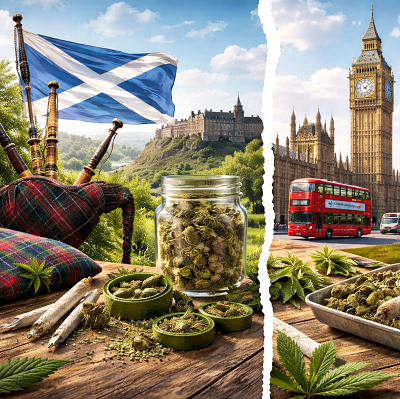
Cannabis Culture in Scotland vs Cannabis Culture in London: Differences Between Urban and Rural Cannabis Subcultures
There are many differences in how cannabis culture is perceived in the United Kingdom. The biggest difference in how cannabis culture is viewed comes down to regional or geographic location. As an example, London is a metropolitan area that is one of the largest and most culturally diverse cities in the world. Scotland is a country located in the north of the U.K., and its population is much smaller and less ethnically diverse compared to London. Both locations have their own cannabis culture, although they have very different origins and histories.
Although cannabis is still illegal for recreational use in all parts of the U.K., there are still many differences in how people view cannabis and the community surrounding it between regions.
Cannabis Culture in London
London’s cannabis culture is a reflection of the city itself. The city is home to residents from around the world, so it is expected that many of the traditions and views regarding cannabis would be different. One of the first examples of this was when Jamaican immigrants moved to London in the middle of the last century and brought their love of cannabis and their reggae music with them. Reggae music and cannabis were quickly tied to the youth culture in areas like Brixton and Notting Hill, where young people used cannabis to express themselves creatively and resist authority.
Music has always played a large role in forming the cannabis culture in London. Hip hop and grime artists frequently mention cannabis in their lyrics and videos. These artists, including Skepta and Stormzy, show the relationship between cannabis and creative inspiration, as well as the urban way of life.
CBD has recently started to play a larger role in cannabis culture in London. Because CBD is legal in the U.K., many retail outlets sell CBD oil, beverages, and edible products that include cannabis derived ingredients, but do not produce the psychoactive effect of THC. This has helped cannabis become seen as a wellness product, as opposed to just a recreational substance.
Cannabis Culture in Scotland
Scotland’s cannabis culture is formed by both urban and rural elements, as well as its political activism. While there are active cannabis cultures in the cities of Glasgow and Edinburgh, Scotland’s cannabis culture is also formed by rural living and activism.
Many people in Scotland support the legalization of cannabis. Some activists and politicians believe that legalization of cannabis can create jobs and stimulate economic activity, especially in agriculture. Hemp can be grown successfully in Scotland, and there has been increasing interest in CBD farming in Scotland in recent years.
For many Scottish farmers, growing cannabis, particularly hemp, represents a potential source of income for rural economies. This has led to debates about whether cannabis should be thought of as a recreational substance, or as an agricultural product.
Cannabis is also sometimes connected to herbalism and natural medicine in rural areas and the Highlands. Historically, many rural communities throughout Scotland have had a tradition of using plant based remedies to treat ailments and illness, and this has contributed to a broader acceptance of herbal approaches to health in rural Scotland.
Urban vs Rural Cannabis Cultures
The differences between the cannabis cultures in London and Scotland demonstrate two very different cannabis cultures.
London’s cannabis culture is predominantly urban and cultural, and closely related to music, nightlife, and the various multicultural communities that exist in the city. CBD wellness trends and creative industries have also contributed to modern cannabis attitudes in the city.
Scottish cannabis culture is more political and agricultural. Many of the discussions surrounding cannabis in Scotland center on economic development and the potential for agriculture, and rural growers and activists are key players in those discussions.
The Future
As the views of cannabis continue to evolve across the U.K., these regional differences may become even more important in the future. London is likely to continue to be a hub for cannabis culture and lifestyle trends, while Scotland may begin to develop a greater presence in agricultural cannabis production and policy-making.
Together, the two opposing cannabis cultures illustrate the importance of regional identity and history in forming cannabis culture.