
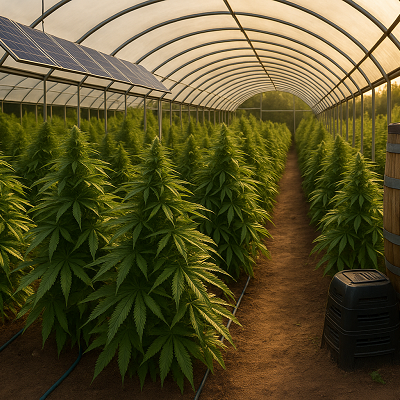
Sustainable Cannabis: How Eco-Friendly Growing Is Changing the Industry
Sustainability is one of the foundations of today’s agricultural practices, and cannabis is no different. With increasing conversations around climate change, resource depletion, and responsibility for our environment, the cannabis industry now has a decision to make. We’re finding that growing practices that used to be about yield and potency, are now being examined for their environmentally conscious practices. Therefore, sustainable cannabis farming is far from a trend, and necessary to face the challenges that the 21st century will bring.
Key Eco-Friendly Changes in Growing
Cannabis cultivation is adapting to major eco-friendly changes in order to minimize harm to our environment, while ensuring product quality:
- LED Grow Lights → Use up to 60% less energy during cultivation as compared to traditional high-pressure sodium (HPS) lamps, while also providing better spectral efficiency.
- Soil Organic Nutrients/Biochar → Reduce even further chemical runoff, while improving soil health, that fits into organic standards outside of cannabis.
- Closed-Loop Water Systems → Recycle water efficiently by reducing waste, in hydroponic grown systems and soil grown.
- Greenhouse Solar Power → Reduce fossil fuel dependence, and tremendously lessen carbon footprints.
These improvements demonstrate a slow shift from extractive agriculture to circular and regenerative agriculture.
The Necessity of Sustainability
The reason for sustainable cannabis cultivation can be viewed through three intersecting viewpoints:
- Consumer Demand: Today’s cannabis consumers — especially in the UK –EU – are are more knowledgeable about sourcing and growing practices. Transparency around growing practices and supply chain cause points of differentiation in the market.
- Regulatory Pressure: Cannabis is quickly transforming from an informal economy to regulated economy, then stricter regulation would require eco-friendly standards in the same way as regulates standards in the food and drink markets.
- Economic Mandate: Growing cost of energy and water usage makes unsustainable cultivation financially infeasible. In the end growers once kept efficiency methods that required less input to minimize inputs.
Social Licence to Operate
Sustainability in regards to cannabis cultivation is not an economic quality or brand awareness quality, but is also a type of cultural legitimacy. Cannabis culture has always associated the cannabis plant with awareness of the environment and counterculture beliefs. To be sustainable in cannabis farming is to become entrenched in the culture with sustainable practices, while providing an economic type of value and viability.
Summary
In summary, the movement towards sustainable cannabis farming is more than environmentally reactive, it is also necessary economically. By adopting, eco-friendly practices – that apply renewable energy, and reduce water, and utilize organic – nutrient practices they will potentially decrease their environmental impacts and create the market a significant measure of trust. Summary further, with these similar thoughts, sustainability may be less of an option or innovative solution, than it is essentially a requirement to sustain the future of the cannabis marketplace.
Discover more cannabis news and information in our blog.